



Translation carries meaning from one language to another and stays close to the source text. Transcreation carries the effect: it rebuilds a message so it makes a new audience feel what the original made the first audience feel, even when few of the original words survive. Use translation for content that informs. Use transcreation for content that persuades. Most global marketing programs need both, and the skill is sorting each asset into the right lane before the work starts.
Irisnow
Keep Local Campaigns On Brand
GearBox helps teams manage localized campaigns, brand assets and approvals across markets and partner networks from one platform.
TL;DR
Table of Contents
What translation does, and where it stops
Translation is the more established discipline. It has an international standard, ISO 17100:2015, which sets requirements for professional translation services. The translator’s job is fidelity: the target text should say what the source says, in natural target-language prose, with consistent terminology.
That is exactly right for a product manual, a safety data sheet, a warranty, a dealer onboarding guide or a price list. Nobody wants a creative interpretation of torque specifications.
It stops working when the source text depends on a pun, a rhythm, a cultural reference or an emotional register. A literal rendering of a tagline can be grammatically perfect and still land flat, or worse, say something unintended. Translation is not uncreative: skilled translators make creative choices constantly. But the brief they work from asks for equivalence, and equivalence is the wrong target for a slogan.
What transcreation does differently
The word is a blend of “translation” and “creation.” The Slator explainer puts the core difference plainly: creativity and the freedom to reinterpret the source text sit at the center of transcreation.
The Institute of Translation and Interpreting’s code of practice defines it as a professional practice that combines translation, copywriting and intercultural consultancy. That combination matters. A transcreator is part linguist, part copywriter and part local-market advisor, and is not expected to keep formal equivalence with the source.
Practitioner research is firm on one point: transcreation is not glorified translation, and it is not a synonym for “creative translation” either. It is its own practice, which is why it needs its own brief, its own process and its own pricing.

A common client fear is that transcreation will lose the original meaning. Practitioners frame it the other way: the goal is to gain the local market’s interest. Meaning that does not move the reader has not really been delivered.
Transcreation vs. translation side by side
FactorTranslationTranscreationGoalAccurate transfer of informationEquivalent emotional effect and brand intentLoyalty to the sourceHigh, sentence by sentenceLoyal to the concept, free with the wordsTypical contentManuals, specs, legal text, help articles, product dataSlogans, taglines, hero campaigns, video scripts, headlinesInputSource text, glossary, style guideCreative brief, audience, desired reaction, brand voiceOutputOne versionOften 2 to 3 options to test or choose fromProcessMostly linear, single deliveryIterative, with back-and-forth and approval roundsPricing logicPer word or hourlyHourly or per projectGovernanceQuality checks against the sourceRationale and back-translation for approvers who do not read the language
The split in outputs and input is drawn from the ITI’s guidance on transcreation briefs, which also notes that transcreation allows more creative freedom than the single-output model of translation.
What each one costs
Budget is where most disagreements start. As of Q2 2025, Slator reports transcreation typically runs 3 to 4 times the cost of translation. Transcreation is often priced at $75 to $250 per hour or $1,500 to $15,000 per project, against $25 to $50 per hour for general translation. Treat those as ranges, not quotes: language pair, market, deliverable count and number of options all move the number.
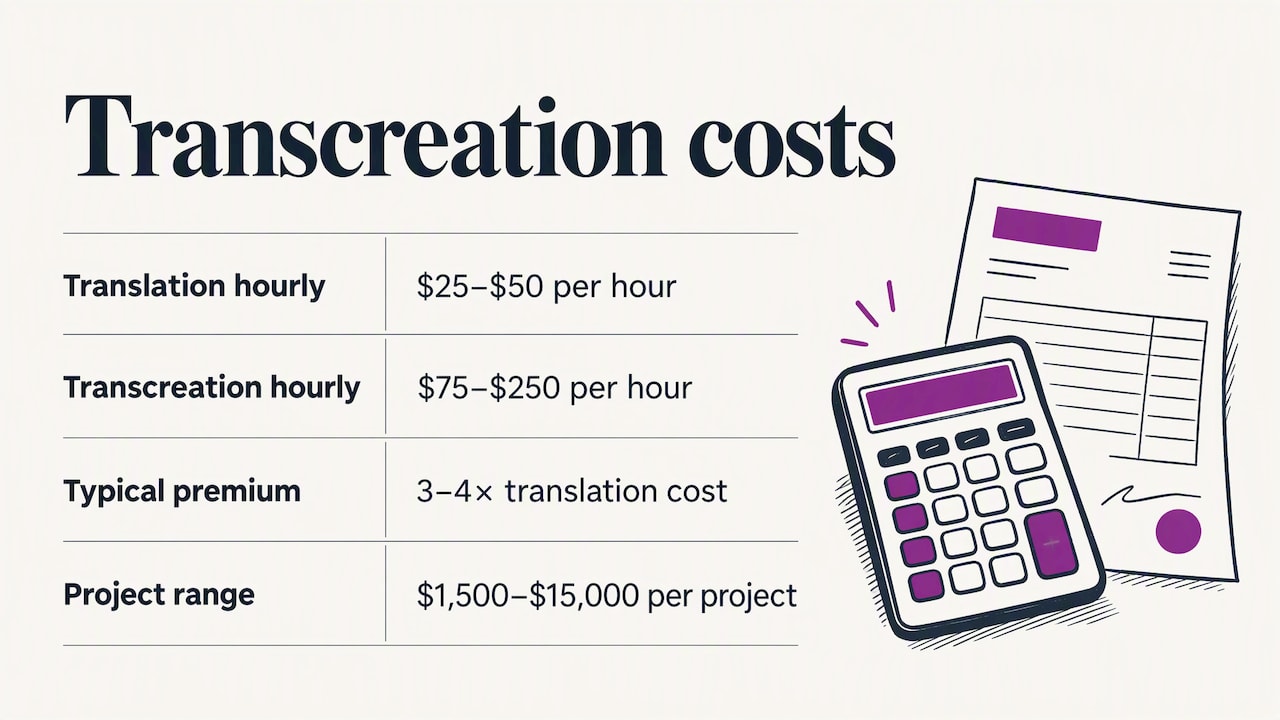
The pricing model matters as much as the rate. Practitioners recommend avoiding per-word pricing for transcreation. The work includes background research, creative exploration and multi-version development, none of which a word count captures. A five-word tagline can take longer than a five-hundred-word brochure.
The cost logic for a marketing leader is simple. Spend the premium where the asset carries the campaign. Do not spend it on content nobody reads for emotion.
Deciding by communicative purpose
The definitions are slippery. Academic work finds no universal definition of transcreation, so vendors use the label inconsistently. The researchers’ advice is to stop forcing every project into a rigid binary and ask about communicative purpose instead: is the text functional, like a product manual, or persuasive, like a brand slogan?
In practice, that gives you three tiers.
Tier 1: Translate
Functional, information-heavy content where accuracy is the whole point.
Tier 2: Translate with a localization pass
Content that is mostly informational but touches local conventions: currencies, units, date formats, imagery, regional product names, local offers. A competent translator or localization specialist handles this, and a reviewer in the market checks it. Co-op ad templates that dealers customize often live here.
Tier 3: Transcreate
Content whose job is to persuade or to carry brand personality.
The RWS guide for marketing leaders describes the same segmentation: successful global programs use standard translation for information-heavy content and keep transcreation for high-impact creative. The most common mistake it names is treating transcreation as a commodity or a sub-type of translation.
The same thinking applies to any content calendar. If you plan international content by purpose rather than by format, as with blending SEO and content marketing, you decide up front which pieces earn creative investment and which just need to be accurate and findable.
What about transliteration and paraphrasing?
Two neighboring terms cause confusion, so settle them early.
Transliteration converts the characters of one writing system into another, for example rendering a brand name in Latin letters or a different script, so that it can be read or pronounced. It does not convey meaning or effect. It is a technical step, not a creative service.
Paraphrasing restates a text in the same language. Transcreation crosses languages and cultures, and it adds a new creative concept where needed. Copywriting is closer: a copywriter writes original persuasive text in one language. A transcreator does that work starting from an existing message in another language and market, within brand constraints.
Writing a transcreation brief that works
Practitioners agree that a robust creative brief is the cornerstone of any transcreation project. A translation brief offers glossaries and style guides. A transcreation brief has to say more:
Practitioners also report that a weak brief is the most common reason projects fail. The same source says to budget and manage these projects as marketing campaigns rather than linguistic tasks.
Rationales and back-translations
Two deliverables confuse first-time buyers. A rationale is a short document explaining the creative choices and how the message was adapted. Experts treat it as a key differentiator for professionals, because the decision-makers approving the work often do not speak the target language.
A back-translation renders the transcreated copy into the source language so approvers can see what it says. Some clients read the request for these as distrust of the vendor. The practitioner research says the opposite: they are a normal part of corporate governance and internal approval for global brands. Plan time for them.
Where AI fits
AI can draft quickly, and it is genuinely useful for brainstorming options. But the evidence is consistent on the limit. A study of AI-powered transcreation in global marketing concludes that output still needs significant human intervention for polish, cultural nuance and brand alignment. Treat AI as a way to speed up first drafts, not as a replacement for the cultural judgment of a native-speaking expert. For high-stakes launches, keep a human in the loop. For low-risk functional content, machine translation with human review can be a sensible tier-one workflow.
Our perspective: the hard part is the workflow, not the word
We build GearBox®, a marketing logistics platform for brands that sell through dealers, distributors, franchisees, agents and advisors. We have spent more than 20 years watching what happens after corporate approves a campaign and hands it to the field. Here is what we have learned about translation and transcreation in that setting.
The language decision is rarely the bottleneck. Brands usually know which headline needs creative treatment. What goes wrong is everything around it. The transcreated tagline lives in an email thread. A local franchisee uses last year’s version. A distributor in another country edits the template and the brand voice drifts. Three approval rounds happen in three tools.
Segmenting by purpose should be built into the system. If the asset library tags each item as translate, localize or transcreate, then local partners get the right version in their language without ever choosing between them. Corporate keeps control, and the partner gets a ready-to-use asset instead of a request form.
Approval hierarchies matter more for transcreation. Since transcreation involves options, rationales and often back-translations, the people approving it need a clear path: global brand, regional lead, local market. When that path is visible and logged, a multi-version project stops feeling like chaos.
Local partners need flexibility inside guardrails. A dealer in Montreal and a dealer in Mexico City should not each commission their own tagline. They should pick from approved variants and personalize the parts corporate allows, such as offers, contact details and store imagery.
This is why GearBox supports multilingual and multicurrency programs, and why Converge® handles global-to-local marketing under one login. Our work with Steelcase, which runs 15,000+ users in 9 countries on the platform, is a good example of how much coordination a global program needs once you leave the home market. For related thinking, see our guides on brand consistency across global markets and local marketing governance and cultural risk.
Governing localized campaigns at scale
Once you know which assets get which treatment, set up the operating model. A workable one looks like this.
Compliance adds a layer. Claims, disclosures and regulated terms differ by region, and a creative adaptation can change a legal meaning. Our pieces on multi-region compliance for CMOs and secure, compliant localized campaigns go deeper on that risk.
Common mistakes to avoid
Managing translation and transcreation in GearBox®
If your brand sells through local partners in several markets, the translation question is really a distribution question: how does the right version of each asset reach the right partner, with the right approvals, without corporate becoming a help desk? GearBox puts campaigns, vendors, co-op funds, orders and brand assets behind one login. It integrates with Adobe DAM and Widen for asset management, and its localized marketing solutions let corporate set the guardrails while partners personalize within them. If you want to see how that would work for your own markets, schedule a demo of GearBox.
FAQ
What is the meaning of transcreation?
Transcreation is the creative recreation of marketing content for a new language and culture. A transcreator works from a creative brief covering audience, brand voice and desired effect, and aims to produce the same emotional impact as the original rather than the same words. It combines translation, copywriting and intercultural consulting.
Is transcreation always more expensive than translation?
Per asset, usually yes. Slator reports a typical premium of 3 to 4 times as of Q2 2025. Over a whole program, though, you may spend less than you expect, because only the persuasive assets need it and the rest stays in the cheaper translation lane.
Can machine translation or AI handle transcreation?
AI can help draft options and speed up brainstorming, but research on AI-powered transcreation finds that human experts are still needed for cultural nuance and brand alignment. For a high-stakes campaign, plan for a native-speaking professional to make the final calls.
Do I need transcreation for every language and market?
No. Decide by communicative purpose and by the market’s importance to the campaign. A launch in a key market may justify a full transcreation with several options, while a secondary market might get a localized version of the approved concept. Information-heavy content rarely needs transcreation anywhere.
What should I ask a transcreation provider before hiring?
Ask how they handle briefs, how many options you receive, whether they provide a rationale and a back-translation, and how they price. The ITI’s code of practice for transcreation is a useful reference for what professional practice looks like.

